

In modern Australia, Catholic organisations are called to act with integrity in a pluralist society that may not always prioritise the same values. Their core objectives—be it education, healthcare, or community and social services - generally reflect that identity; the ‘back-end’ operations that sustain them, however, may be subject to forces that detract from mission.
A recent
CDF Catholic Connect workshop, hosted by Catholic Development Fund (CDF) in partnership with Catholic Social Services Victoria (CSSV), challenged leaders to look deeper into how policies and processes reflect the Catholic mission. The session, ‘Aligning Organisational Practices with Mission’, explored how Catholic Social Teaching can be intentionally embedded across core operations, from procurement and investment to hiring and governance.
Lessons and Learnings with Industry Experts
Four panel and workshop presenters brought strong sector experience and deep insight:
- Tarang Jain (Modern Slavery Liason Officer / Group Procurement Lead ESG, St Vincent’s Health Australia)
- Melissa Halliday (Community Development Project Coordinator, ACRATH)
- Dr John Ballard (Board Director Mercy Education and Catholic Development Fund / Leadership and Governance Consultant)
- Anna Brazier (Climate Justice Coordinator, Jesuit Social Services)
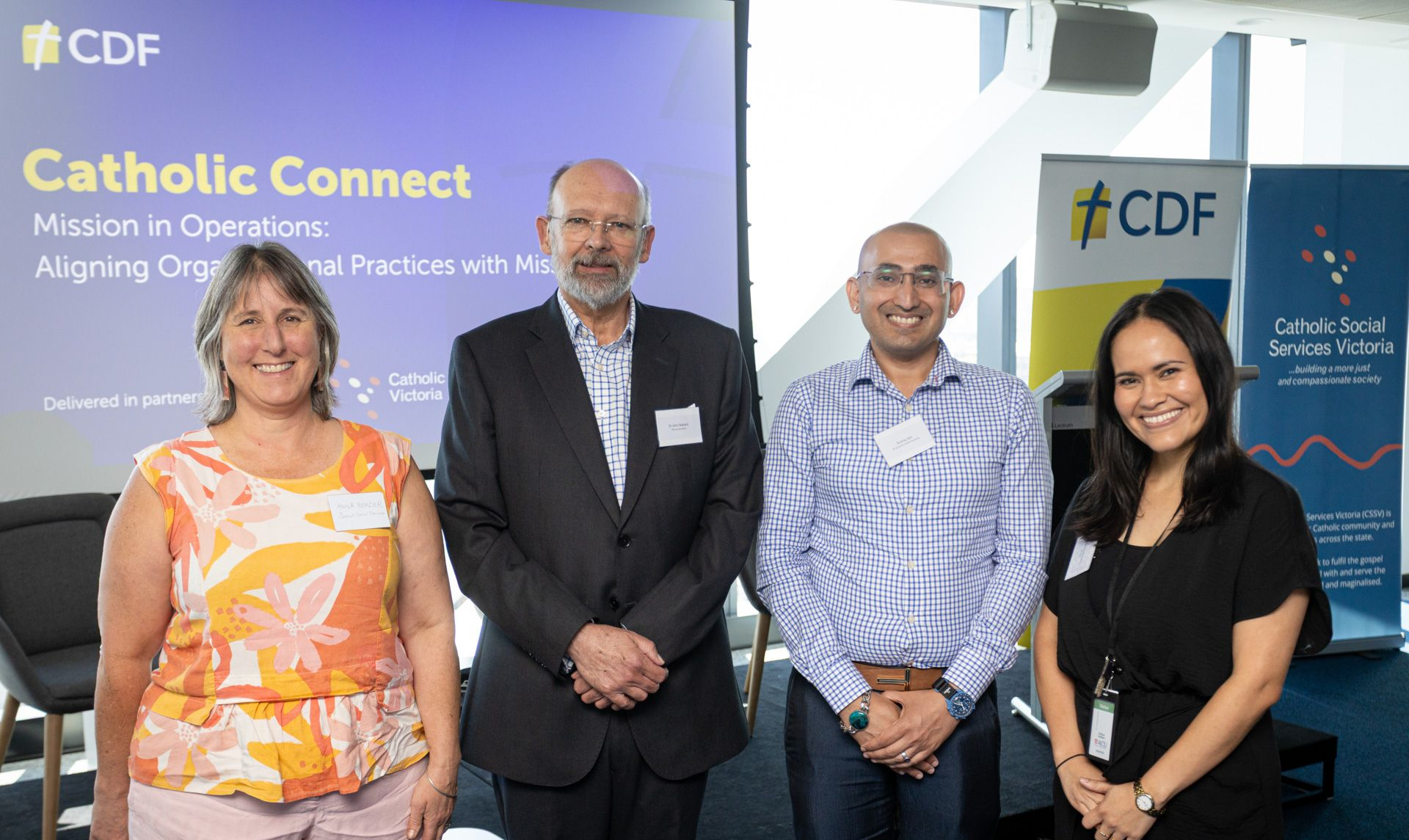
CDF Catholic Connect panelists from left to right: Anna Brazier, Dr John Ballard, Tarang Jain and Melissa Halliday.
Josh Lourensz, Executive director of
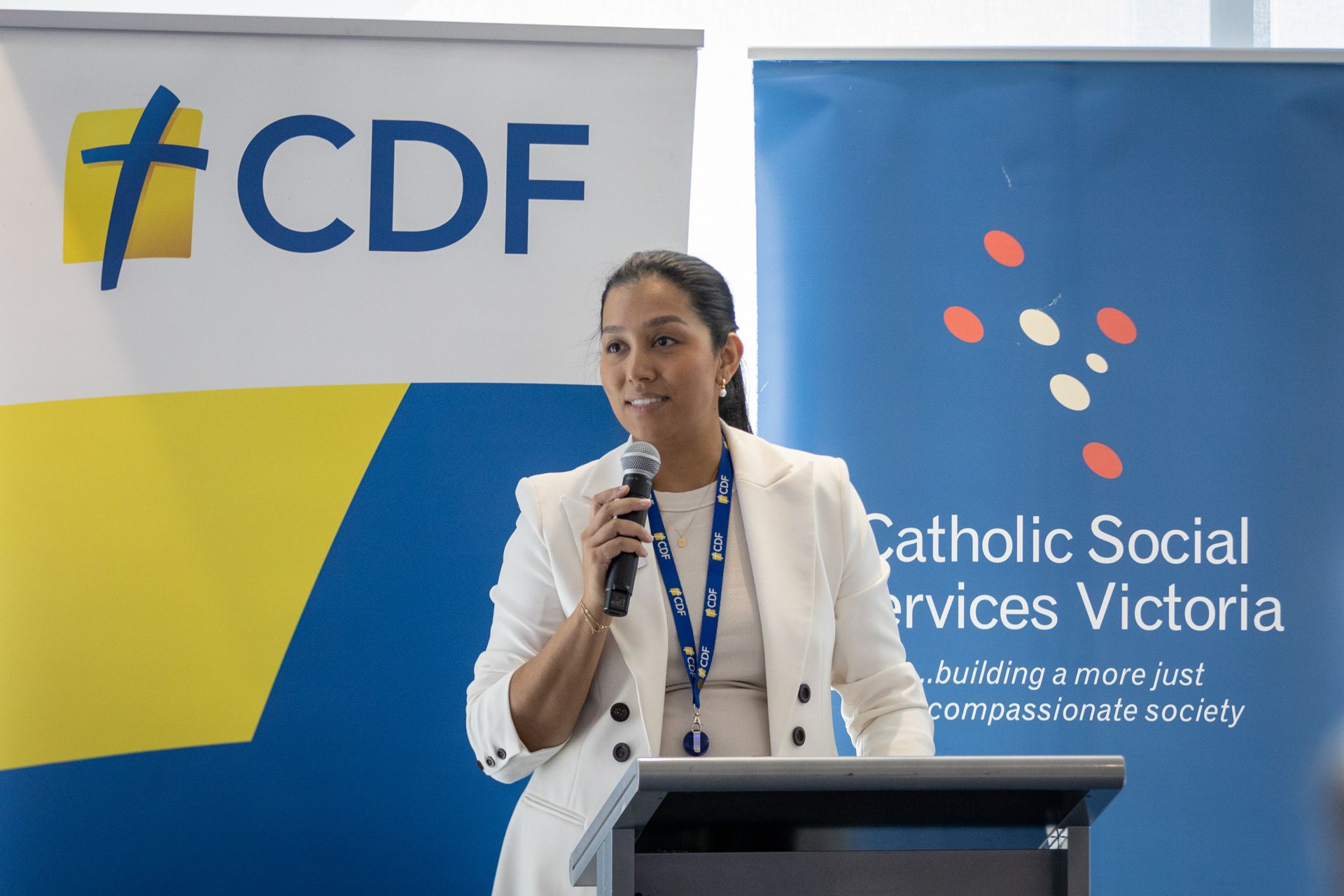
Catholic Social Services Victoria, opened the discussion by pointing to the invisible threads connecting everyday business decisions to global justice issues. ‘Our work is to educate, to serve. But if we’re not seeing every aspect of our work being aligned with Catholic social principles, and the things that are really quite profound in the tradition from which all our organisations spring, then we’re actually not quite doing what we’re meant to do.’
"If we aren’t truly working to the alignment with our mission, if we aren’t taking the time to discern, we’re at the risk of losing our credibility."
Panel moderator Melissa Halliday of ACRATH (Australian Catholic Religious Against Trafficking in Humans), framed the conversation around integrity, asking the panel to consider what is at stake when there is a gap between an organisation’s stated values and its everyday practices. The first speaker, Jesuit Social Services climate justice coordinator Anna Brazier, argued that the ‘heart’ of the organisation is on the line.
‘It’s our essence of who we are, and it’s our identity. If we aren’t truly working to the alignment with our mission, if we aren’t taking the time to discern, we’re at the risk of losing our credibility,’ she said. ‘And if we aren’t brave and we don’t speak truth to power, or if we fall into that cycle of chasing funding cycles, or we’re too scared to bite the hand that feeds us, then how can we maintain our integrity and credibility as a Catholic organisation?’
Not living by Catholic values, Ms Brazier said, leaves staff and clients underserved. In her area of work- ecological and therefore social justice - entire communities lose. ‘It’s our home, it’s the earth, it’s the ecology that sustains us that’s at stake,’ she said.
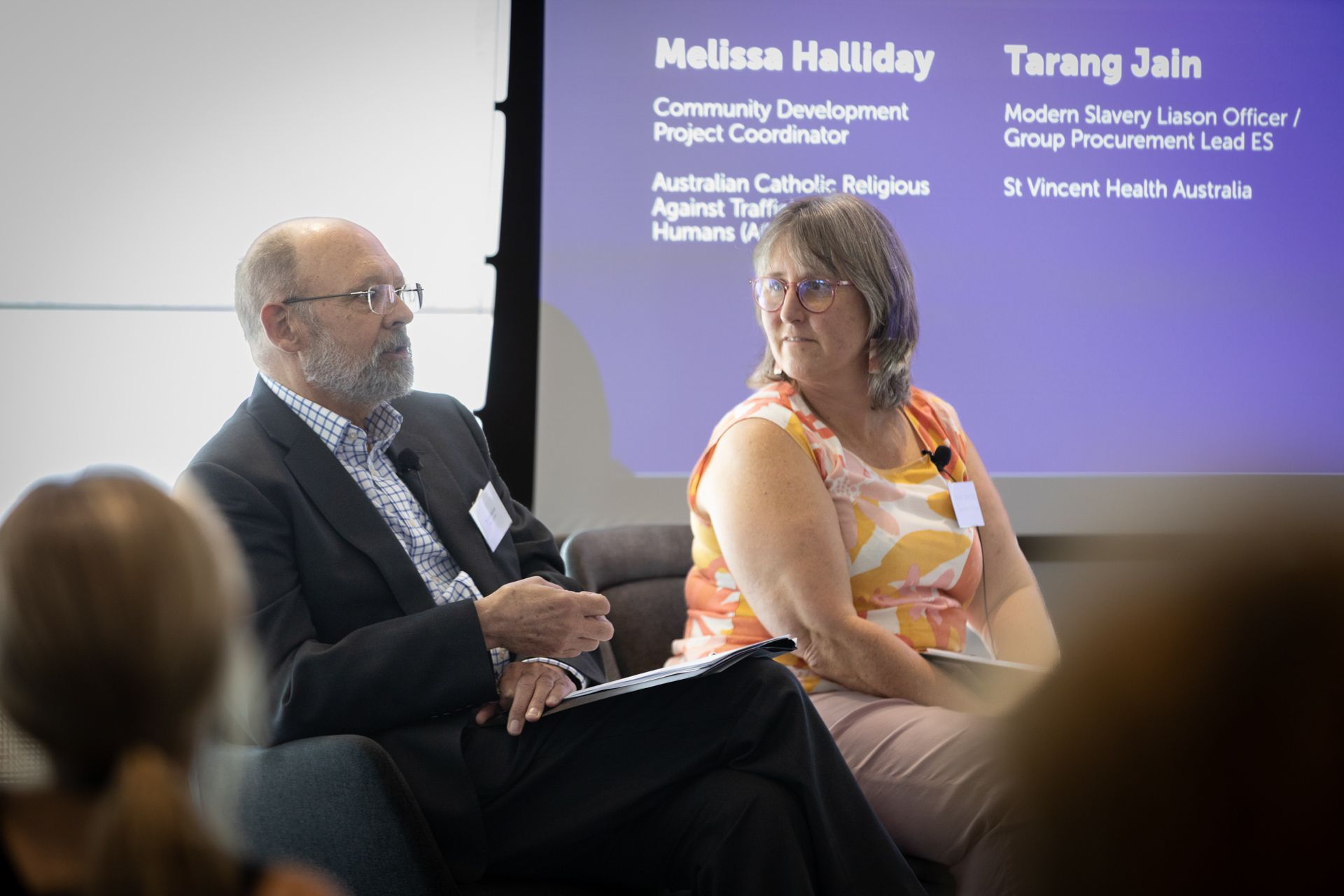

Tarang Jain, of St Vincent’s Health Australia, investigates modern slavery as part of his role as procurement lead. For him, looking inwards at how mission applies to human resources and the treatment of staff is vital. ‘It’s often easy for us to go out and start looking at the vulnerable people in the society and community, but I would say, how about we start looking at in our own backyard?’ he said.
‘We’ve got a really massive workforce, around 30,000 people across the country. It was interesting to observe that more than 20 per cent of our workforce is on visas, so almost 5,000 people are migrants.’ Some migrant groups are susceptible to exploitation, which could include deceptive recruitment, Mr Jain said. So he and his team have begun addressing those vulnerabilities and making sure that staff and colleagues are protected.
As for modern slavery and procurement, Mr Jain argued against a purely punitive approach to suppliers found doing the wrong thing. With every product that an organisation might consider buying, ‘there is a high likelihood that it may have some association with some kind of exploitation happening somewhere throughout its value chain. One option for us as the buyers is that we can choose to terminate our relationship. But is that the right thing to do?’ he asked.
"[Organisations aren’t] staffed by heart- and mind-readers. They cannot operate on an implicit understanding. Mission has to be clear."
Taking an empathetic approach to doing business - the ‘walking with’ of Catholic Social Teaching - means understanding that potentially thousands of families could lose their livelihoods if a trading relationship is cut, Mr Jain said. ‘We felt that there must be a solution for us, and we are still trialling it ... It’s a collaborative way where we are [allowing] our suppliers to be transparent with us, in opening up if there is any risk within their supply chain, and we do not wish to penalise them.
Instead, they aim to have ‘that collaborative, compassionate lens to allow the supplier to be open, transparent, and [to] work with them to fix and remediate the issue’.


Faces of Humanity

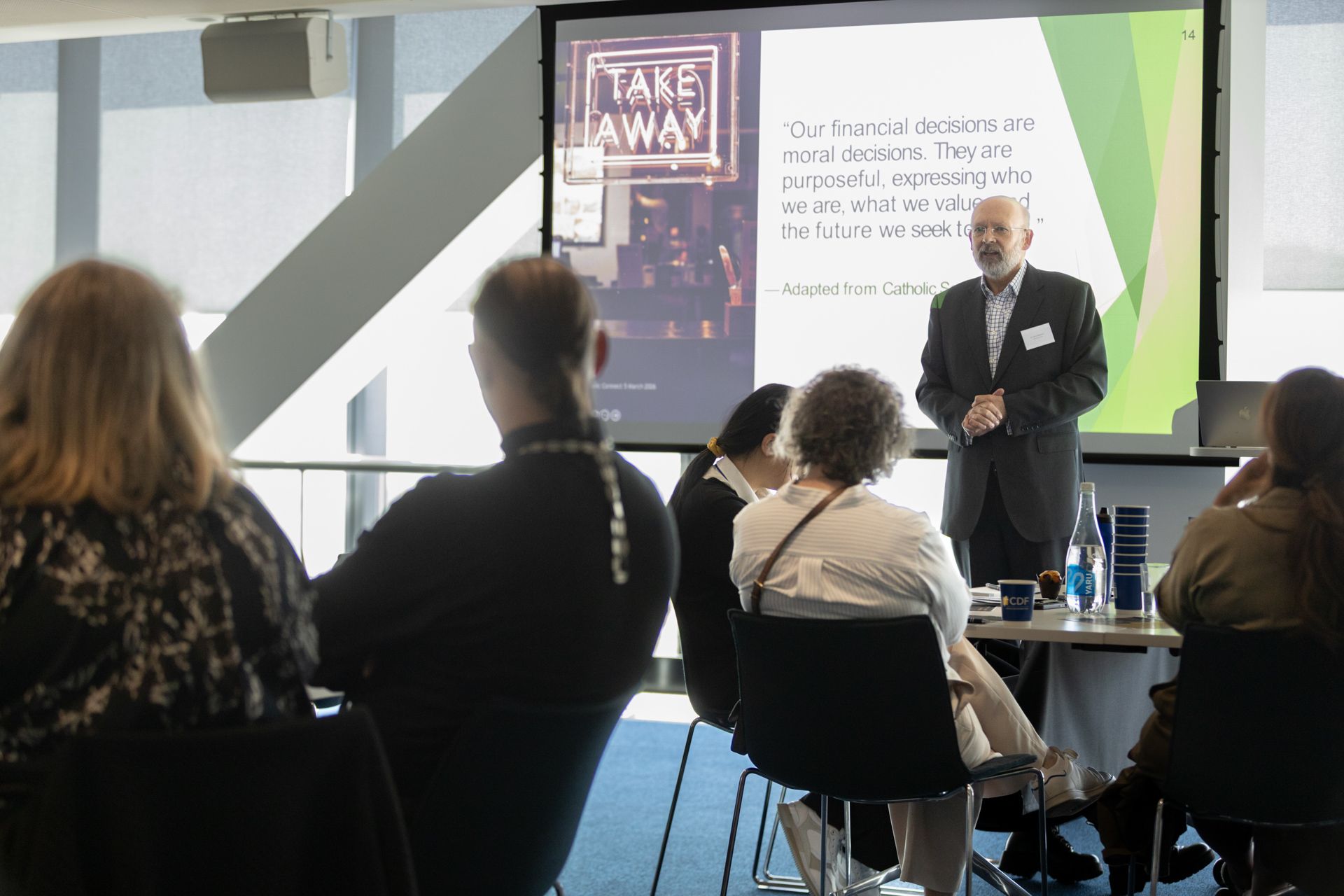
Dr John Ballard, an expert in ethical leadership and governance, challenged the notion that ‘mission’ is an easy topic, saying alignment must be explicitly developed. ‘Starting with first principles is revisiting the mission: What is our mission? What’s our purpose? And it requires deliberate, robust board level discussion and not assumptions,’ he said.
‘The mission has to be intelligible, not just heartfelt. I believe that leaders may “know it in their heart”, but the organisation isn’t staffed by heart- and mind-readers. They cannot operate on an implicit understanding. Mission has to be clear to those serving the ministry, and clarity enables action.’
"Leaders have to honestly ask what are they prepared to give up to achieve genuine, ethical outcomes for the common good."
It requires asking how the corporate purpose genuinely reflects and serves the charism.
Dr Ballard noted that true commitment to the common good often requires sacrifice, and this applies especially to the ‘corporatised ministry’ of many modern Catholic organisations.
‘In an unequal world, leaders have to honestly ask what are they prepared to give up to achieve genuine, ethical outcomes for the common good. That’s always where the common good falls over, which is why I come back to “set up the first principles”. You start with the ministry. What’s your purpose?’
Anna Brazier explained how Jesuit Social Services has formalised its purpose, through an ‘environmental way of proceeding’, which integrates business processes with human spirit. ‘It’s when you’re thinking about your waste streams, your procurement, your carbon accounting, your divestment policy. But sitting alongside that, we also [need] to think about how ecological justice is embedded within our practice,’ Ms Brazier said.
The workshop concluded with a powerful story from Dr Ballard about his time as CEO of Mercy Health, illustrating how financial logic can sometimes blind boards to mission-critical needs. He recounted how the finance committee at the time disagreed with his proposal to redevelop an aged-care facility, suggesting it was too financially risky.
‘As they never visited a facility, they may have little insight into what we do or [what] was needed there. I asked our next meeting to be on site. They agreed, and that was a turning point,’ Dr Ballard said.
"Mission clarity shifts outcomes."
‘Financial logic alone can block mission-critical decisions. Board and committee members gain materially different insights when they see the operations, the people and the conditions firsthand. When they got out there, they saw how daggy the buildings were and how unsuited they were.
‘Seeing the substandard facilities … reframed perceived risk of investment. The risk was if we did not invest. Mission clarity shifts outcomes, reconnecting decision-makers to organisational purpose and service need. It unlocked support that the financial modelling alone couldn’t do.’
As Catholic organisations continue to navigate a complex environment, the workshop highlighted how in very diverse Catholic organisations, mission is lived through the integrity of every policy, process and decision made behind the scenes.
Full Story: Melbourne Catholic
Images: Catholic Development Fund
Share this article:
Related articles



CDPF Limited, a company established by the Australian Catholic Bishops Conference, has indemnified the Catholic Development Fund ABN 15 274 943 760 (the Fund) against any liability arising out of a claim by investors in the Fund. In practice, this means your investment is backed by the assets of the Catholic Archdiocese of Melbourne. The Fund is required by law to make the following disclosure. Investment in the Fund is only intended to attract investors whose primary purpose for making their investment is to support the charitable purposes of the Fund. Investors’ funds will be used to generate a return to the Fund that will be applied to further the charitable works of the Archdiocese of Melbourne and the Dioceses of Sale and Bunbury. The Fund is not prudentially supervised by the Australian Prudential Regulation Authority nor has it been examined or approved by the Australian Securities and Investments Commission (ASIC). An investor in the Fund will not receive the benefit of the financial claims scheme or the depositor protection provisions in the Banking Act 1959 (Cth). The investments that the Fund offers are not subject to the usual protections for investors under the Corporations Act (Cth) or regulation by ASIC. Investors may be unable to get some or all of their money back when the investor expects or at all and investments in the Fund are not comparable to investments with banks, finance companies or fund managers. The Fund’s identification statement may be viewed here or by contacting the Fund. The Fund does not hold an Australian Financial Services Licence.