
Take a Second, Stay Secure: Protecting Your Data When Using AI
October 4, 2026

Artificial intelligence is quickly becoming part of everyday work. Generative AI tools can help draft emails, summarise documents, analyse information, generate ideas and make everyday tasks more efficient.


But using AI can also mean sharing information with an external system. 


The Australian Signals Directorate’s Australian Cyber Security Centre (ACSC) highlights that while AI offers significant opportunities for organisations, it also introduces cyber security and data risks that need to be understood and managed. 


This Cyber Security Awareness Month, there’s a simple habit we can all adopt: Take a second, stay secure. 


Before you type, paste or upload information into an AI tool, stop and consider what you’re sharing and whether it really needs to be there.


The copy and paste problem


Imagine you need to summarise a lengthy report. Uploading the whole document into an AI tool takes seconds and gives you an answer almost immediately. 


But what else was in that document? 


Names. Contact details. Financial information. Employee or client information. Internal business information. 


The intention wasn't to disclose sensitive information. You were simply trying to get a job done faster. 


The risk wasn't necessarily using AI. It was sharing more information than the task required. 


ACSC guidance emphasises the importance of protecting sensitive, proprietary and mission-critical data throughout the use of AI systems. 


Pause. Check.Protect

The same three steps that can help protect you from scams can also provide a useful habit when working with AI.

  • PAUSE: before you prompt

    Take a second before entering or uploading information. 


    Ask yourself: Does this AI tool really need this information to complete the task? 


    Never enter passwords, PINs, verification codes or banking credentials. Be particularly careful with personal information, client or customer data, confidential documents, financial information and commercially sensitive material.

  • CHECK: what are you sharing and where?

    Know which AI tool you are using and follow your organisation's policies for approved technology. 


    Consider whether names, account details, addresses, financial figures or other identifying information can be removed before using AI. 


    Don’t assume that because an AI tool is easy to access, all information is appropriate to share with it. 

  • PROTECT: your information and your organisation

    Use approved tools and security settings, minimise the information you provide and avoid uploading sensitive information unnecessarily. 


    If you're uncertain whether information should be entered into an AI system, don't share it until you've checked with your manager, IT team or your organisation's information security or privacy team. 

  • PAUSE: before you prompt

    Take a second before entering or uploading information. 


    Ask yourself: Does this AI tool really need this information to complete the task? 


    Never enter passwords, PINs, verification codes or banking credentials. Be particularly careful with personal information, client or customer data, confidential documents, financial information and commercially sensitive material.

  • CHECK: what are you sharing and where?

    Know which AI tool you are using and follow your organisation's policies for approved technology. 


    Consider whether names, account details, addresses, financial figures or other identifying information can be removed before using AI. 


    Don’t assume that because an AI tool is easy to access, all information is appropriate to share with it. 

  • PROTECT: your information and your organisation

    Use approved tools and security settings, minimise the information you provide and avoid uploading sensitive information unnecessarily. 


    If you're uncertain whether information should be entered into an AI system, don't share it until you've checked with your manager, IT team or your organisation's information security or privacy team. 


Take a second before trusting the answer, too


Protecting what goes into AI is only part of the equation. 


AI-generated responses can contain incorrect, incomplete or misleading information. An answer can sound convincing without being accurate. 


So the same principle applies on the way out: 


Pause before you use it. Check important information. Protect your organisation by applying human judgement. 


Important facts, calculations, sources and recommendations should be independently checked, particularly when they could influence financial, operational or organisational decisions. 


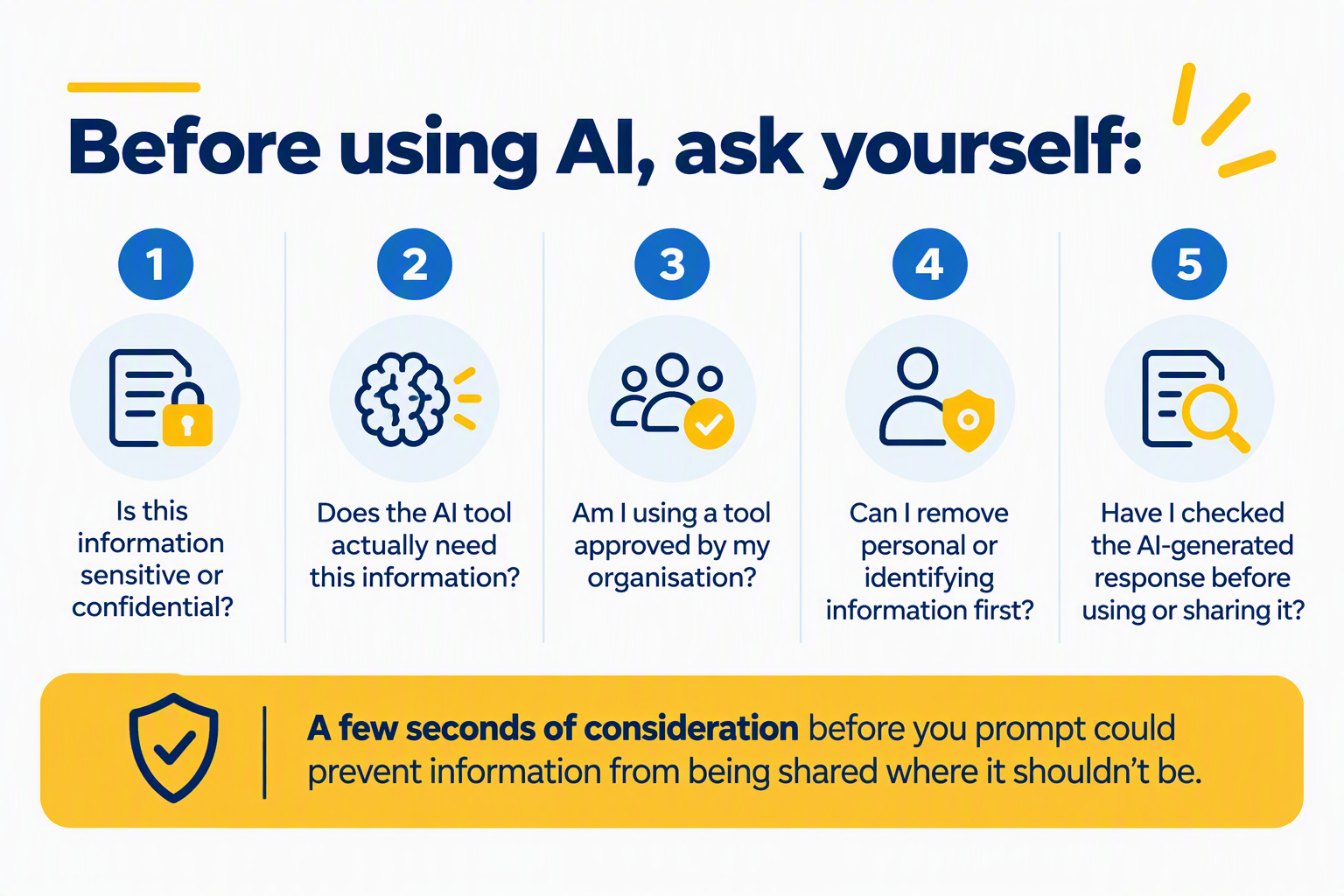
Five questions before you prompt
Learn more this Cyber Security Awareness Month


Cyber security is a shared responsibility, and staying informed is one of the simplest ways we can strengthen our collective protection. 


As part of Cyber Security Awareness Month, Securing Australia Together 2026 will bring together the National Cyber Security Coordinator and chief security officers from Australia's major banks for a live online panel discussion on cyber security. 

Securing Australia Together 2026

A live online panel discussion featuring the National Cyber Security Coordinator and chief security officers from Australia's major banks.

Register now

For more practical information about scams, cyber security and ways to protect yourself and your organisation, visit the CDF Security Centre.

Visit the CDF Security Centre

For further Australian Government guidance on using AI securely:

Artificial Intelligence Guidance

Securing Australia Together 2026


A live online panel discussion featuring the National Cyber Security Coordinator and chief security officers from Australia's major banks.


Contact your Relationship Manager or CDF Client Services (csg@melbcdf.org.au or 1800 134 135) for your special access code.

Register now: Securing Australia Together 2026

For more practical information about scams, cyber security and ways to protect yourself and your organisation, visit the CDF Security Centre.

Visit the CDF Security Centre

For further Australian Government guidance on using AI securely:

Artificial Intelligence Guidance

Share this article:

Related articles

By Hillaria Juliana • September 30, 2026
Whether you’re saving for a family holiday, a new car, an emergency fund, or a future milestone, it’s natural to focus on the objective. But lasting progress often starts with something less tangible: our mindset and the habits we build along the way. The way we think about money, our confidence in managing it, and the habits we build along the way can shape our ability to save. Research into financial wellbeing suggests that financial confidence is influenced by more than just income or financial knowledge. Our behaviours, routines, and day-to-day decisions all play an important role in helping us feel in control of our finances ( Ecstra, 2026 ). Most meaningful savings journeys don’t require perfect conditions or large sums of money to begin.
September 29, 2026
Ground has been broken on St Francis; a $150 million retirement living community in East Ivanhoe and the latest expression of Villa Maria Catholic Homes' (VMCH) long-standing commitment to creating places where people can live well, remain connected and be supported through every stage of life. CDF is proud to support the development with a $90 million loan, continuing a partnership with VMCH that has helped bring some of Victoria's most significant Catholic aged care and retirement living projects to life.
September 23, 2026
For more than four decades, Assumption Catholic Primary School has provided Catholic education in Mandurah, Western Australia, welcoming children and families into a community grounded in faith, learning, service and belonging. Founded in the spirit of the Presentation Sisters, Assumption continues that tradition through its motto, ‘United in Christ’, with a commitment to help every child flourish in mind, heart, body and spirit. Now, a $2.4 million refurbishment of the school’s Senior Teaching Block is giving an established part of the campus a new future. Supported by a $2.3 million loan from CDF, the project has transformed classrooms for students in Years 3 to 6. For new Principal Colin Loh, the investment reflects Assumption’s commitment to providing an education that responds to the needs of today’s students while remaining grounded in its Catholic identity.
More

CDPF Limited, a company established by the Australian Catholic Bishops Conference, has indemnified the Catholic Development Fund ABN 15 274 943 760 (the Fund) against any liability arising out of a claim by investors in the Fund. In practice, this means your investment is backed by the assets of the Catholic Archdiocese of Melbourne. The Fund is required by law to make the following disclosure. Investment in the Fund is only intended to attract investors whose primary purpose for making their investment is to support the charitable purposes of the Fund. Investors’ funds will be used to generate a return to the Fund that will be applied to further the charitable works of the Archdiocese of Melbourne and the Dioceses of Sale and Bunbury. The Fund is not prudentially supervised by the Australian Prudential Regulation Authority nor has it been examined or approved by the Australian Securities and Investments Commission (ASIC). An investor in the Fund will not receive the benefit of the financial claims scheme or the depositor protection provisions in the Banking Act 1959 (Cth). The investments that the Fund offers are not subject to the usual protections for investors under the Corporations Act (Cth) or regulation by ASIC. Investors may be unable to get some or all of their money back when the investor expects or at all and investments in the Fund are not comparable to investments with banks, finance companies or fund managers. The Fund’s identification statement may be viewed here or by contacting the Fund. The Fund does not hold an Australian Financial Services Licence.